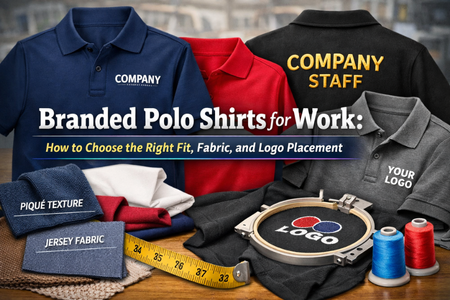
Branded Polo Shirts for Work: How to Choose the Right Fit, Fabric, and Logo Placement
Branded polo shirts look simple on the surface.
Pick a colour. Add a logo. Done.
Except that’s exactly where most businesses go wrong.
We see it all the time: teams order branded polo shirts that look fine on day one, but after a few weeks, the fit feels off, the fabric loses shape, the logo doesn’t sit quite right, and suddenly the “uniform” looks more like mismatched casualwear. The frustrating part? It was avoidable.
Choosing the right branded polo shirts isn’t about grabbing the cheapest option and uploading a logo. It’s about understanding how fabric behaves after repeated washing, how different cuts fit real teams (not mannequins), and why logo placement can make the difference between something that looks professional and something that looks promotional.
That’s why polos remain one of the most popular workwear choices across the UK. They strike the balance between smart and practical, which is exactly why businesses across trades, offices, hospitality, and events continue to rely on them. But to get that balance right, the details matter.
A well-chosen polo, like the Uneek Classic Polo Shirt or the consistently popular Uneek Contrast Polo Shirt, holds its shape, carries embroidery cleanly, and still looks sharp months down the line. Choose the wrong fabric or fit, and even the best logo won’t save it.
This guide is written for businesses that don’t want to guess.
We’ll break down:
- Which fabrics actually work for everyday wear
- How polo sizing behaves across mixed teams
- Where logos should go if you want that proper “uniform” look
- When embroidery is the right call, and when it isn’t
We’ll also show you how to avoid common mistakes that lead to returns, wasted spend, and inconsistent branding, while pointing you towards polo options that are proven performers in real working environments. If you’re already at the stage where you’re browsing options in the main workwear collection, you can explore the full range of polos and related garments via the shop as you read.
By the end of this guide, you’ll know exactly which polo shirts make sense for your team, how to brand them properly, and how to order with confidence, without trial and error.
What Most Businesses Get Wrong with Branded Polo Shirts
Most issues with branded polo shirts don’t show up at checkout.
They show up weeks later, once the polos are worn, washed, and seen in public.
Here are the two mistakes we see most often.
Choosing the Cheapest Fabric (And Why It Backfires)
Low-cost polos look similar on screen. In reality, fabric quality is what decides whether a polo lasts months or years.
Cheaper polos are often:
- Lightweight to the point of feeling flimsy
- Prone to twisting after washing
- More likely to shrink or lose shape
- Poor at holding embroidery cleanly
That’s why polos designed specifically for workwear, like the Uneek Classic Polo Shirt, perform better over time. The fabric weight and knit structure are built to handle regular washing without collapsing or stretching out.
Straight answer:
If the polo feels thin in your hand, it won’t hold its shape on the job.
Ignoring Logo Placement and Stitch Size
This is the fastest way to make branded polos look cheap.
Common mistakes:
- Logos placed too low on the chest
- Oversized embroidery on lightweight fabric
- Stitch density that overwhelms the garment
A well-placed logo on a structured polo, like the Uneek Contrast Polo Shirt, sits naturally on the body and reads clearly without pulling or puckering.
Rule of thumb for polos:
- Left chest placement looks professional
- Small to medium logos work best
- Embroidery should enhance the garment, not dominate it
Quick Fix Checklist
- Avoid ultra-lightweight polos for work use
- Choose fabrics designed for embroidery
- Keep logos proportional to the garment
- Prioritise shape retention over price
These small decisions are what separate a proper uniform from “just a branded top”.
Fabric & Weight Explained
When people ask, “Which branded polo shirts are best?” what they’re really asking is:
Which polos still look good after 30 washes?
Fabric choice answers that.
Piqué vs Jersey (What They Actually Feel Like)
Most work polos fall into one of these two fabric types.
Piqué polos
This is the classic workwear option.
- Textured knit (tiny waffle pattern)
- Holds structure well
- Breathable without feeling thin
- Embroidery sits clean and flat
This is why polos like the Uneek Classic Polo Shirt are widely used for uniforms. They look smart without feeling stiff.
Jersey polos
These feel more like a t-shirt.
- Smooth, soft surface
- More casual appearance
- Less forgiving with embroidery
- Can show wear faster in high-use roles
Straight answer:
If the polo needs to look professional, piqué wins almost every time.
Cotton vs Poly Blends (What Lasts Longer at Work)
Fabric content matters more than most people realise.
| Fabric Type | Feels Like | Wash Performance | Best For |
| 100% Cotton | Soft, natural | Can shrink or lose shape | Light office use |
| Cotton / Poly Blend | Balanced | Holds shape better | Most work environments |
| Performance Polyester | Lightweight, technical | Excellent durability | Active, outdoor roles |
For teams that move, sweat, or work outdoors, performance polos like the AWDis Cool Polo Shirt are designed to stay breathable while keeping logos sharp.
Why Fabric Weight Matters More Than Price
Fabric weight is measured in GSM (grams per square metre), but you don’t need to memorise numbers.
Here’s the simple version:
- Too light → shows wear, twists after washing, and embroidery can ripple
- Too heavy → feels stiff, uncomfortable in warm conditions
- Mid-weight → best balance of comfort, durability, and appearance
This is why mid-weight work polos consistently outperform budget options. They’re built to be worn repeatedly, not just once.
Quick Fabric Decision Guide
- Want a smart uniform look → Piqué cotton blend
- Want durability and easy washing → Cotton/poly mix
- Want performance and moisture control → Technical polyester
- Want embroidery to look clean → Avoid thin jersey polos
If you’re ordering polos for a team, fabric choice is what protects your spend long-term, not the logo method or colour.
Fit & Sizing (How to Avoid Returns and Wasted Spend)
Sizing mistakes are where branded polo budgets quietly bleed.
Not because people guess wrong, but because they assume everyone wears polos the same way. They don’t.
True-to-Size vs Fitted Cuts (What Teams Prefer in Reality)
Most work polos fall into two fit categories:
Regular / true-to-size
- More forgiving across body types
- Safer for mixed teams
- Less likely to trigger exchanges
This is why classic cuts like the Uneek Classic Polo Shirt are widely used for company uniforms. They suit more people without needing individual adjustments.
Fitted / modern cuts
- Sharper appearance
- Tighter through chest and arms
- Higher risk of sizing complaints
Direct answer:
If one size has to work for many people, regular fit wins.
Mixed Teams: How Businesses Get Sizing Wrong
Common mistake:
Ordering one or two sizes in bulk and hoping for the best.
What actually works better:
- Broader size spread
- Fewer units per size
- Prioritising M–XL, but not ignoring S or XXL
Polos designed for workwear, like the Uneek Contrast Polo Shirt, tend to scale more predictably across sizes, which reduces surprises when orders arrive.
The Simple Sizing Spreadsheet Approach (That Saves Money)
This works especially well for teams of 10+.
Before ordering:
- Share a sizing chart screenshot
- Ask each team member for their usual size
- Ask one extra question: “Do you prefer loose or fitted?”
Then adjust:
- Loose preference → size up if between sizes
- Fitted preference → stay true to size
This one step dramatically reduces reorders.
Fit + Fabric = Final Outcome
Fit doesn’t exist in isolation.
- Lightweight fabrics show tightness more
- Heavier fabrics feel restrictive if undersized
- Embroidery exaggerates a poor fit
That’s why choosing the right polo and the right size matters more than chasing the lowest price.
Quick Sizing Rules
- Ordering for a mixed team → regular fit
- Unsure between sizes → size up
- Embroidered polos → avoid tight fits
- Fewer returns → broader size spread
Logo Placement That Looks “Proper” (Not Cheap)
Logo placement is one of the biggest signals of quality on a branded polo.
Same shirt. Same logo.
Different placement, completely different perception.
This is where a lot of businesses accidentally make their polos look like promo giveaways instead of uniforms.
Left Chest: The Professional Default (For a Reason)
There’s a reason this placement dominates uniforms across construction, hospitality, offices, and trade teams.
Why it works:
- Sits naturally in the eye line
- Balanced visually with the collar
- Doesn’t distort when the wearer moves
- Works on all body types
This is the safest choice for embroidered polos, especially structured garments like the Uneek Olympic Polo Shirt, where stitch density and fabric weight support clean embroidery.
Best for:
- Company uniforms
- Front-of-house teams
- Trades and service businesses
- Long-term workwear
Rule of thumb:
If you want polos that still look good after 50 washes, start here.
Sleeve Branding: Subtle, Premium, Underused
Sleeve logos are often overlooked, which is exactly why they work so well.
Placed correctly, sleeve branding:
- Feels modern and intentional
- Avoids cluttering the chest
- Adds brand presence without shouting
This works particularly well on contrast polos like the Uneek Contrast Polo Shirt, where stitching can visually tie into trim details.
What to keep in mind:
- Smaller logo size
- Embroidery almost always beats print
- Left sleeve is usually cleaner visually
Sleeve logos signal confidence. They say: “We didn’t need to overdo it.”
Back Logo: When It Makes Sense (And When It Doesn’t)
Back logos divide opinion, and for good reason.
They work well when:
- Staff need to be identifiable from behind
- The logo is simple and legible
- The garment is worn in active roles
They don’t work when:
- The logo is detailed
- The fabric is lightweight
- The polo is meant to look corporate
For more active or moisture-wicking polos, such as the AWDis Cool Polo Shirt, a small upper-back print can be practical without overpowering the garment.
Direct answer:
Back logos are functional, not fashionable. Use them deliberately.
Logo Size: Bigger Isn’t Better
This is where a lot of polos fall apart.
Common mistake:
- Oversized logos “to be seen”
What actually happens:
- Fabric pulls
- Stitch density becomes obvious
- The polo loses shape over time
Recommended sizing (general guide):
- Left chest embroidery: small to medium
- Sleeve logo: small
- Back logo: medium only if printed
Clean logos age better. Always.
Embroidery Placement vs Print Placement (Quick Rule)
- Small logo + left chest → embroidery
- Large logo + back → print
- Sleeve logo → embroidery
- Multiple placements → keep one subtle
If you’re unsure, embroidery on the left chest is the lowest-risk option for long-term uniforms.
Placement Mistakes That Kill Professionalism
Avoid these:
- Logos too close to buttons
- Logos stitched too low on the chest
- Logos crossing seams
- Multiple large logos competing for attention
These mistakes are hard to unsee once you notice them, and they cheapen the entire uniform.
Quick Placement Summary
- Most professionals look → left chest embroidery
- Most premium accent → sleeve logo
- Most visible from distance → upper back
- Least risk overall → small, clean placement
Embroidery vs Print on Polos (The Fast, Correct Decision)
This is where most buyers hesitate.
And hesitation kills conversions.
So let’s remove the confusion.
If you remember nothing else from this guide, remember this section.
The Short Rule
- Small logo → embroidery
- Large logo → print
- Uniform polos → embroidery
- Event/promo polos → print
That rule alone solves 80% of bad decisions.
Now let’s explain why, without overcomplicating it.
Why Embroidery Wins on Polo Shirts
Polos were built for embroidery.
The fabric structure, collar shape, and chest area all support stitched logos better than flat prints.
Embroidery works best when:
- The logo is small to medium
- The placement is left chest or sleeve
- The polo is worn weekly (or daily)
- You care about longevity
On classic work polos like the Uneek Olympic Polo Shirt, embroidery:
- Holds its shape
- Doesn’t crack or fade
- Looks better over time
This is why embroidery dominates uniforms across trades, offices, and hospitality.
When Print Actually Makes More Sense
Print isn’t bad, it’s just often misused.
Print wins when:
- The logo is large
- The design includes gradients or fine detail
- The polo is for short-term use
- The garment is lightweight or performance-focused
For moisture-wicking polos like the AWDis Cool Polo Shirt, the print can feel lighter and more flexible, especially for active roles.
Key point:
Print is about visual impact.
Embroidery is about professional credibility.
Durability Comparison (Real-World Use)
Here’s what actually happens after repeated washes:
| Factor | Embroidery | |
| Wash resistance | Excellent | Medium |
| Fade risk | Very low | Moderate |
| Fabric distortion | Low (if sized right) | None |
| Lifespan | Years | Months to years |
| Uniform appearance | Strong | Variable |
This is why businesses ordering long-term uniforms nearly always default to embroidery.
Comfort & Feel (What Wearers Notice)
Employees care about comfort, even if they don’t say it.
- Embroidery adds slight weight but stays breathable
- Print feels lighter but can trap heat if oversized
On thicker polos like the Uneek Contrast Polo Shirt, embroidery sits cleanly without irritation when logo size is kept sensible.
Oversized embroidery on thin fabric, however, is a mistake. Always match the method to the garment’s weight.
Cost: What Actually Drives the Price
This surprises people.
Embroidery costs more when:
- Stitch count is high
- Logo is large
- Placement is complex
Print costs more when:
- Quantity is low
- Multiple colours are involved
- Special finishes are used
For small chest logos on polos, embroidery is often a better value long-term, even if the upfront cost is slightly higher.
Can You Mix Both on the Same Polo?
Yes, but do it carefully.
A smart combo:
- Embroidered logo on the chest
- Small printed detail on the back
This works best for:
- Events
- Branded staff launches
- Promotional uniforms with longevity
Less is more. Always.
Quick Decision Checklist
- Want polos to last years → embroidery
- Want maximum visibility → print
- Ordering for staff uniforms → embroidery
- Ordering for events → print
Who Branded Polo Shirts Are Actually Best For
Polos aren’t a “default” garment.
They’re a signal.
When used correctly, they say professional, reliable, and organised.
When used badly, they just look cheap.
Here’s where polos genuinely work best.
Trades + Office-Based Teams
This is the sweet spot.
Polos bridge the gap between casual and formal. They look right on-site and in meetings.
Best setup:
- Mid-weight polo
- Embroidered left chest logo
- Neutral colours (black, navy, charcoal)
This is exactly why polos like the Uneek Olympic Polo Shirt are so popular for long-term workwear. They hold their shape, wash well, and still look sharp after months of use.
Hospitality & Front-of-House
Here, polos aren’t about toughness. They’re about presentation.
Guests judge professionalism in seconds.
For hospitality:
- Softer fabric
- Slimmer cut
- Clean embroidery (small logo only)
Contrast detailing, like on the Uneek Contrast Polo Shirt, helps staff stand out without being overly noticeable.
Events, Promotions & Short-Term Teams
This is where rules relax slightly.
If polos are worn for:
- A single event
- A campaign
- A seasonal promotion
Then:
- Print can make sense
- Larger logos are acceptable
- Lighter fabrics work
Performance polos, such as the AWDis Cool Polo Shirt, are ideal here, as they are breathable, modern, and comfortable for long days.
Frequently Asked Questions
What’s the best polo shirt for embroidery?
Mid-weight piqué polos with a tight weave perform best. They hold stitches cleanly and don’t pucker around the logo after washing.
How long does it take to get branded polo shirts?
Once artwork is approved, production typically takes a few working days. You can choose your delivery date when ordering to match launches or staff start dates.
Can I mix different polo styles in one order?
Yes. Many businesses mix men’s and women’s fits or different polo styles in the same order to suit varied roles or body types.
Will embroidery damage the fabric?
No, as long as the logo size and stitch count are appropriate for the fabric weight. This is checked before production.
Final Recommendation (The Smart Way to Buy)
If you’re buying polos for work, don’t overthink it, but don’t cut corners either.
Do this:
- Choose one reliable core polo
- Use embroidery for small logos
- Stick to classic placements
- Order enough for rotation
Then build from there.
If you’re ready to move from research to action, start by browsing available styles in the main shop and shortlist two or three polos that fit your team’s role and environment.
From there, it’s simply about choosing your logo placement and delivery date, and letting the uniforms do their job.
That’s how branded polo shirts stop being an expense and start becoming an asset.