
Embroidery vs Printing on Workwear: Which Looks More Professional (and Lasts Longer)?
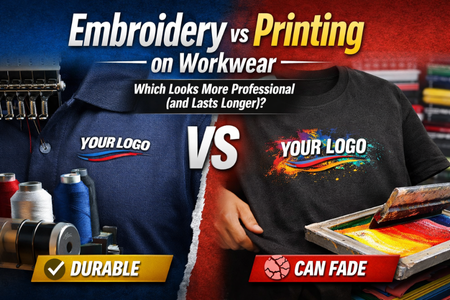
You’ve probably already done the hard part.
You’ve decided what your team should wear. You’ve got the logo ready. You’re finally at the point where you can order.
And then you hit the question that makes everyone pause:
Should you embroider the logo… or print it?
Because this isn’t a tiny design choice. It affects how professional the uniform looks on day one, how it feels to wear for an 8–10 hour shift, and whether it still looks sharp after weeks of washes.
That’s why “embroidery vs printing workwear” is such a common decision-stage search. People don’t want theory. They want to know what actually holds up in real life.
Here’s the simplest way to think about it:
If you want that raised, “proper uniform” finish, the kind that instantly feels more premium, embroidery tends to win, especially on polos. Something like the Uneek Contrast Polo Shirt is a great example of where a clean embroidered left-chest logo can make your staff look instantly more established.
But if you need bigger designs, bolder branding, or front-and-back prints (think events, trades, gyms, promo teams), printing can look better, and often comes out cheaper depending on the artwork. Hoodies are where this decision gets interesting. A staple like the Sprint Hoodie can suit either method, but the “best” choice depends on whether you want a small premium logo or a larger statement design.
Outerwear is another story. Jackets take more abuse, get worn in tougher conditions, and the wrong method can look tired fast. That’s why on something like the Regatta Surrender Contrast Soft Shell Jacket, durability and finish matter as much as price.
And if you’re buying for safety-critical roles, hi-vis isn’t just “another garment”. It’s compliance, visibility, and hard-wearing performance. A product like the Yoko Hi-Vis Kensington Jacket needs branding that lasts without peeling, cracking, or looking scruffy after heavy use.
So if you’re here because you’re ready to order and you don’t want to choose wrong, you’re in the right place.
By the end of this guide, you’ll know exactly when embroidery is the smarter call, when printing makes more sense, and how to choose based on the garment type, so you can place the order confidently through the LogoMeUp shop and stop second-guessing it.
Quick Answer: Embroidery vs Printing on Workwear (At a Glance)
If you want the fastest answer, here it is.
Choose embroidery if:
- You want a professional, uniform-style finish
- The logo is small to medium-sized (e.g. left chest)
- The garment will be washed frequently
- You’re branding polos, jackets, fleeces, or corporate uniforms
- Longevity matters more than upfront cost
This is why embroidery works so well on staples like the Uneek Contrast Polo Shirt and outerwear such as the Regatta Surrender Contrast Soft Shell Jacket. The stitching physically becomes part of the garment, so it doesn’t peel, crack, or fade in the same way prints can.
Choose printing if:
- You have large designs, text blocks, or gradients
- You need front-and-back branding
- You’re working with hoodies, T-shirts, or promotional wear
- You’re ordering short runs or event clothing
- Budget is a key factor
Printing is often the better option on garments like the Sprint Hoodie, especially when the design covers a wider area or includes colours that embroidery can’t replicate cleanly.
Embroidery vs Printing: Quick Comparison Table
| Feature | Embroidery | Printing |
| Overall look | Premium, structured, “uniform” feel | Flat, modern, casual |
| Durability | Excellent (thread doesn’t peel or crack) | Good, but varies by print type |
| Wash performance | Holds shape and colour over time | Can fade or crack with heavy washing |
| Best for | Polos, jackets, fleeces, corporate wear | Hoodies, T-shirts, promo clothing |
| Logo size | Small to medium | Small to very large |
| Upfront cost | Higher for large stitch counts | Often cheaper for large designs |
How Embroidery and Printing Actually Work
Most confusion around embroidery vs printing comes from not understanding what’s physically happening to the garment. Once you understand that, the decision becomes far more obvious.
Embroidery: Thread, Stitch Count, and Fabric Tension
Embroidery works by stitching your logo directly into the garment using coloured threads. Those stitches penetrate the fabric and lock the design in place.
That’s why embroidery performs so well on structured garments like polos, fleeces, and jackets. On something like the Uneek Contrast Polo Shirt, the fabric is stable enough to support tight stitching without distortion, which results in a clean, professional finish.
What actually matters with embroidery:
- Stitch count – more stitches = more detail and higher cost
- Thread density – affects how bold and durable the logo looks
- Fabric weight – heavier garments handle embroidery better
Because embroidery becomes part of the garment, it holds up exceptionally well on outerwear like the Regatta Surrender Contrast Soft Shell Jacket, where wash durability and long-term appearance are critical.
Printing: Ink, Film, and Surface Bonding
Printing applies your design onto the garment rather than through it. Depending on the method, this could be ink absorbed into the fabric or a film bonded to the surface.
This is why printing excels on garments designed for comfort, movement, or bold visuals. A hoodie like the Sprint Hoodie is a great example. The fabric is soft, flexible, and ideal for larger prints across the chest or back.
Key factors that affect print performance:
- Print method (screen print, DTG, transfer)
- Ink or film quality
- Wash temperature and drying habits
Printing allows for:
- Larger designs
- Fine gradients and colour transitions
- Front-and-back branding without high cost
However, because printing sits on the surface, it’s naturally more sensitive to repeated high-temperature washes and tumble drying.
Why This Matters in the Real World
Here’s the part most people miss.
If your team wears branded clothing daily, embroidery usually wins because it resists wear and maintains its shape over time. If the clothing is worn occasionally, for events or promotions, printing often makes more sense.
That’s why high-wear garments like polos and jackets are usually embroidered, while hoodies, T-shirts, and campaign wear are more often printed.
This isn’t about which method is “better”.
It’s about choosing the method that matches how the garment will actually be used.
Durability & Wash Performance (What Really Lasts)
This is where the embroidery vs printing decision stops being theoretical and starts costing (or saving) money.
Most workwear doesn’t fail on day one.
It fails after 30 washes, weekly tumble drying, and real working conditions.
What Fades First: Print or Thread?
Embroidery almost always outlasts print.
Why? Because the thread doesn’t sit on the garment. It’s stitched into it.
On high-rotation items like embroidered polos (for example, the Uneek Contrast Polo Shirt), the logo typically looks the same months later as it did on day one. Colours stay solid. Edges stay sharp. No peeling, no cracking.
Printing behaves differently:
- Screen prints can fade over time
- Transfers can crack or lift
- DTG prints may soften or lose contrast after repeated washing
That doesn’t make printing “bad”. It just means it has a shorter visual lifespan under heavy use.
Industrial Washing, Tumble Drying & Workwear Abuse
This is where embroidery really pulls ahead.
In environments where garments are:
- Washed at 40–60°C
- Tumble-dried regularly
- Worn daily on-site or on the road
…embroidery consistently performs better.
That’s why embroidery is the default choice for outerwear like the Regatta Surrender Contrast Soft Shell Jacket. Jackets take more abuse, are washed less gently, and are expected to look professional for longer.
Printing, especially on soft garments like hoodies, still performs well, but only when care instructions are followed. On items like the Sprint Hoodie, printing works best when:
- Washed inside out
- Kept below high heat
- Air-dried where possible
Real-World Durability Comparison
| Scenario | Embroidery | Printing |
| Daily uniform wear | Excellent | Moderate |
| Frequent washing | Very strong | Depends on the method |
| Tumble drying | Low risk | Higher risk |
| Long-term appearance | Maintains shape & colour | Gradual fade or wear |
| Professional presentation over time | Consistent | Variable |
The Cost of Replacing Worn Branding
Here’s an angle most guides ignore, but buyers care about.
A cheaper print that needs replacing sooner often costs more over time than an embroidery that lasts longer. Especially when you factor in:
- Reordering garments
- Inconsistent branding across teams
- Downtime while replacements arrive
That’s why embroidery is still the go-to for uniforms, while printing is used strategically for promotional or seasonal clothing.
Look, Feel & Professional Perception (Why It Matters More Than You Think)
At some point, this stops being about threads or ink.
It becomes about how your brand is perceived the moment someone sees your team.
Why Embroidery Signals “Uniform” and Authority
There’s a reason embroidery dominates in industries where trust matters.
Embroidered logos are associated with:
- Established businesses
- Corporate uniforms
- Trades, logistics, facilities, and professional services
The raised texture, stitch depth, and permanence give embroidered workwear a structured, official feel. On garments like embroidered polos and jackets, the logo looks issued, not promotional.
That’s exactly why embroidery works so well on pieces such as the Uneek Contrast Polo Shirt and structured outerwear like the Regatta Surrender Contrast Soft Shell Jacket. The logo feels like part of the uniform, not an add-on.
From a customer’s point of view:
- Embroidery feels permanent
- Permanent feels established
- Established feels trustworthy
That chain reaction is why embroidered uniforms are still the default in sectors where first impressions matter.
When Printing Looks Better (And More Modern)
Printing has its own strengths, and in the right context, it looks better than embroidery.
Printing works visually when:
- The logo is large or complex
- The design includes gradients or fine detail
- Branding is bold and expressive, not formal
- The garment is worn casually or socially
On softer garments like hoodies, printing often feels more natural. A printed logo on the Sprint Hoodie looks intentional, modern, and comfortable, especially for internal teams, events, or customer-facing casual environments.
Printing also allows for:
- Full-width chest designs
- Back prints with messaging
- Campaign or seasonal branding
In these cases, embroidery can feel too rigid or visually cramped.
How Customers Read Your Branding (Even If They Don’t Realise It)
People don’t consciously analyse logo methods, but they react to them instantly.
Here’s how branding is typically interpreted:
| Branding Style | Perceived Message |
| Embroidered logo | Professional, reliable, long-term |
| Printed logo | Casual, creative, promotional |
| Small embroidered chest | Uniform, authority |
| Large printed front/back | Event, campaign, team identity |
This is why many businesses don’t choose one method. They use both, depending on the garment’s role.
The Smart Approach: Match the Method to the Message
If the garment represents your business in public, embroidery usually sends the right signal.
If the garment is for:
- Internal teams
- Events
- Giveaways
- Casual wear
Printing often delivers a better visual result.
The strongest brands don’t ask, “Which is better?”
They ask, “What is this garment meant to communicate?”
Cost Comparison: What Actually Makes Embroidery or Printing Cheaper (or More Expensive)
This is the point where most guides get it wrong.
The cost difference between embroidery and printing isn’t about the method alone. It’s driven by logo size, detail, quantity, and where the logo goes on the garment.
Here’s how it really works.
The Single Biggest Cost Driver: Logo Size
This one factor explains most pricing confusion.
Small logos (left chest, sleeve, cap front)
Embroidery is usually more cost-effective long-term.
A compact embroidered logo on garments like the Uneek Contrast Polo Shirt uses a controlled stitch count, stays durable, and avoids the setup inefficiencies that printing can introduce on small designs.
Result:
Higher perceived value with minimal extra cost.
Large logos (full chest, back prints, statement designs)
Printing almost always wins.
Once a design gets large, embroidery requires:
- Significantly higher stitch counts
- Longer machine time
- More thread density
At that point, printing becomes the smarter option, especially on garments designed for comfort and movement like the Sprint Hoodie.
Quantity: Small Runs vs Bulk Orders
This is where buying behaviour matters more than branding preference.
Low quantities (4–20 garments)
Printing is often cheaper upfront.
There’s less production time, less setup complexity, and faster turnaround. That’s why printing is popular for:
- Events
- Startups
- Short-term campaigns
Medium to large orders (25+ garments)
Embroidery starts to scale better.
Once setup is absorbed, embroidery delivers consistent results across large batches, especially on uniforms and outerwear like the Regatta Surrender Contrast Soft Shell Jacket.
Cost Comparison Table
| Factor | Embroidery | Printing |
| Small logo (left chest) | Cost-effective | Often less efficient |
| Large logo | Expensive | Cost-efficient |
| Low quantities | Higher per unit | Lower per unit |
| Bulk orders | Scales well | Scales well |
| Long-term value | High | Medium |
| Replacement frequency | Low | Higher |
The Hidden Cost Most Buyers Miss
Upfront price isn’t the full story.
Printing that fades or cracks faster often leads to:
- Reordering garments sooner
- Inconsistent branding across teams
- Extra admin and downtime
Embroidery, while sometimes costing more initially, often reduces total spend over time for businesses that need consistency.
That’s why many organisations use:
- Embroidery for core uniforms
- Printing for campaigns, events, or seasonal wear
It’s not either/or. It’s strategic.
Best Choice by Garment Type (No Guesswork)
This is where most buyers want clarity. Not theory, practical answers by product.
Polo Shirts: Clean, Professional, Long-Term Wear
For polos, embroidery is usually the correct choice.
Polos are structured garments. They’re worn close to the face, often in customer-facing roles, and washed regularly. Embroidery holds its shape, stays sharp, and reinforces a professional image over time.
That’s why embroidered polos like the Uneek Contrast Polo Shirt are a go-to for businesses that want consistent branding without constant replacement.
Best choice:
✔ Embroidery for left chest logos
✔ Printing only for large promotional designs
Hoodies: Comfort First, Visual Impact Matters
Hoodies sit at the crossover between workwear and casualwear. That changes the equation.
Printing often works better here, especially when:
- Logos are large
- Designs include colour gradients
- Branding sits front-and-back
A garment like the Sprint Hoodie is designed for flexibility and comfort. Printing complements that by keeping the fabric soft and visually bold.
That said, embroidery still works well for small chest logos, especially when hoodies are used as part of a uniform rather than casual wear.
Best choice:
✔ Printing for bold designs
✔ Embroidery for subtle, uniform-style branding
Jackets: Where Embroidery Is Non-Negotiable
If there’s one category where embroidery almost always wins, it’s jackets.
Outerwear takes more abuse:
- Weather exposure
- Frequent washing
- Heavy daily use
Printing can work, but embroidery delivers superior durability and a more premium look. That’s why jackets like the Regatta Surrender Contrast Soft Shell Jacket are typically embroidered for long-term branding.
Best choice:
✔ Embroidery for all professional outerwear
✔ Printing only for temporary or promotional use
Hi-Vis: Compliance Comes First
Hi-vis isn’t just about branding. It’s about visibility standards.
Embroidery is often preferred for durability, but logo placement and thread colour must not interfere with reflective strips or safety compliance. Printing can sometimes offer more flexibility in placement, depending on the garment.
A hi-vis option like the Yoko Hi-Vis Kensington Jacket is typically branded with compliance in mind first, aesthetics second.
Best choice:
✔ Method depends on garment design and placement
✔ Compliance always overrides preference
FAQs
Does embroidery damage fabric?
No, when done correctly. Embroidery uses stabilisers and stitch densities matched to the fabric, which prevents pulling or distortion on quality garments.
Is embroidery more expensive than printing?
Not always. Small logos on uniforms are often cost-effective when embroidered. Large designs tend to be cheaper when printed.
Which lasts longer?
Embroidery almost always lasts longer under frequent washing and daily wear.
Can you combine embroidery and printing on the same garment?
Yes, and many businesses do. For example, an embroidered chest logo with a printed back design is common on hoodies and jackets.
Embroidery vs Printing: Decision Cheat Sheet
| Scenario | Best Choice |
| Daily uniforms | Embroidery |
| Customer-facing roles | Embroidery |
| Events & promotions | Printing |
| Large designs | Printing |
| Long-term brand consistency | Embroidery |
| Casual or campaign wear | Printing |
Final Recommendation (Straight Answer)
If you’re buying workwear that represents your business day in, day out, embroidery is usually the right investment.
If you’re creating clothing for:
- Events
- Promotions
- Casual teams
- Bold visual impact
Printing often delivers better flexibility and lower upfront cost.
The strongest brands don’t choose one method universally.
They choose the right method for the job.
If you’re ready to apply this to real garments, you can explore options across polos, hoodies, jackets, and hi-vis directly via the full workwear range, and choose the branding method that fits how your team actually works.