
Branded Workwear for Small Businesses: How to Order Small Runs Without Paying Over the Odds
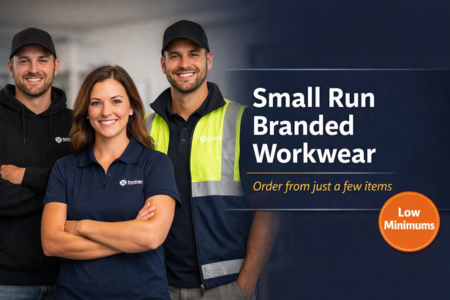
Small businesses have a very specific problem with branded workwear.
You do not need 200 units. You need 6 polos for the team, a couple of hoodies for colder days, maybe two hi-vis tops for site visits… and you need it to look like a proper uniform, not a mismatched mix of “close enough”.
The frustrating part is that small orders are where suppliers often get awkward. Setup fees appear out of nowhere. Minimums creep up. Or you get treated like your order is “too small to bother”, which usually shows up as rushed proofs, inconsistent logo sizing, and deliveries that feel like a gamble.
This guide is here to remove that stress.
We are going to break down how branded workwear for small businesses actually works in plain English, including what to check before you buy, how small order quantities can still look premium, and how to avoid paying over the odds just because you are not ordering in bulk. You will also learn how to set up a repeatable, uniform system so reorders match, even as your team grows.
If you are ordering for a specific date, bookmark the Order Process so you understand exactly when proof approval happens. If you are trying to keep costs predictable, start with Price Locked options. And if you want to sanity-check quality before you commit, have a quick look at our Feedback page to see what real buyers say after the order arrives.
Short, practical, and built for real small business buying decisions.
The real problem with small-run workwear
Small-run workwear is not hard because you are ordering “too little”.
It is hard because small businesses get hit with small-order penalties in sneaky ways.
You do not see it as a line item called “small business tax”. You see it as setup fees, inconsistent branding, and orders that arrive looking like three different uniforms.
Here are the real problems small businesses run into, and what to look for instead.
1) Setup fees and “minimum spend” traps
A lot of suppliers treat small order quantities like an inconvenience. So they recover margin by adding:
- setup fees for print or embroidery
- minimum spends that force you to overbuy
- inflated unit pricing that makes “just 6 items” feel ridiculous
For small teams, that is a deal-breaker. You should be able to place a small order and still get a clean, professional result without paying over the odds.
If you want to keep costs predictable, start by browsing Price Locked garments, then build from there.
2) Inconsistent logos across reorders
This is the one that quietly kills brand perception.
Your first order looks fine. Then you reorder later, and the logo is a different size, slightly different colour, or positioned higher or lower. Nobody says anything. But it looks messy.
Consistency comes down to:
- same garment base (or a controlled set of garments)
- the same logo file and sizing rules
- proof approval that is treated seriously
If you are planning small runs, it is worth choosing from a tight selection first so you can reorder without chaos. Start with the Selected Garments hub, then narrow to the categories you actually need.
3) Suppliers who rush proofs (or skip the details)
When you are ordering a few items, the proof is your insurance policy. It is where you catch:
- logos that are too big or too small
- placement that looks “stuck on”
- fine details that will not print cleanly at the chosen size
- spelling or formatting mistakes
If you do not know how the proof stage fits into the timeline and dispatch, read the Order Process once. It prevents “we needed it last week” panic later.
4) The wrong garment mix (too many random items)
Small businesses often overcomplicate the first order. They buy nine different garments, in different fits, from different brands, with different logo placements.
It sounds flexible. It usually looks inconsistent.
A cleaner approach is:
- one core top (tee or polo)
- one layer (hoodie or jacket)
If you are customer-facing, start with something that reads as uniform, like Polo Shirts. If you need warmth and daily practicality, compare Hoodies or Jackets.
What a good small-run supplier should offer
Use this as your quick filter:
- proofing built into the process (not treated as optional)
- transparent pricing without setup surprises
- low minimum orders that suit small teams
- reliable dispatch and delivery expectations
- consistency support for reorders
If you want to ask a simple question before you commit, use the Contact page and tell us what you need, how many items, and when you need delivery. That one message usually saves small businesses a lot of unnecessary rework.
How small orders actually work
Small orders are not complicated. They just need a clear process so you do not get stung by surprises.
Here is how small-run branded workwear for small businesses works in the real world, step by step, with the buyer’s questions answered as we go.
Can I order just a few items?
Yes. Small order quantities are normal, especially for new teams, startups, and growing businesses.
The smarter question is: what is the minimum logo run, and what is included in the process?
LogoMeUp is built around low minimums (often 4 items), which is exactly what small businesses need when they are starting a uniform from scratch.
If you want to build a small starter set without overthinking it, start in Selected Garments and choose one core top and one layer.
Minimums: what should I check before I buy?
Before you place any small order, check:
- Minimum order quantity (per logo, per garment, or per order)
- Set-up fees (do they exist, and when do they apply)
- Reorder ability (can you match the same item later)
- Proofing (is a digital proof included before production starts)
If you want predictable pricing from the start, use Price Locked as your first filter.
Why proof approval is your insurance policy
Proof approval is where small businesses save money.
Because when you only order 6 items, a mistake is not “a small percentage”. It is the whole order.
Before you approve a proof, check:
- Logo placement (left chest, front, back)
- Logo size (does it look like uniform branding or promo merch)
- Spacing and alignment
- Colour accuracy (especially if you have a strict brand colour)
- Fine detail readability (thin lines, small text)
- Spelling and punctuation
If you have never ordered branded clothing before, read the Order Process once. It shows exactly where proofing sits, so you do not assume production starts before you have approved anything.
How long do small orders take in the UK?
Small orders can be fast, but the timeline depends on two things:
- How quickly will you approve the proof
- Whether you change garments, placement, or sizing after the proof is made
The fastest orders are the ones where the buyer:
- chooses a straightforward garment
- uses a clean logo layout
- approves the proof quickly with no changes
If you need something that works as a uniform with minimal back-and-forth, start with stable basics like Polo Shirts for smart teams or Hoodies for trades and outdoor work.
Delivery date planning: how to avoid “we needed it last week” panic
If you have a deadline, do this:
- Set your delivery date target first
- Place the order early enough to allow for proof changes
- Avoid last-minute logo edits or garment swaps
Most deadline panic is caused by rushed decision-making, not slow production.
Quick buyer takeaways
- Yes, you can order small quantities, but check minimums per logo and any setup fees.
- Always approve a digital proof before production.
- Fast turnaround depends on quick proof approval and minimal changes.
- Choose simple, repeatable garments so reorders match.
- Plan around your delivery date, not around hope.
If you want the safest answer for your exact situation, use the Contact page and tell us: item types, quantities, logo placement, and your deadline.
The best garments for small businesses starting from scratch
If you are starting a uniform from zero, do not overbuild it. Small businesses waste money by buying too many random items that do not match.
The low-regret play is simple: pick 1 core top + 1 layer. That gets you a consistent look, easy reorders, and a team that actually wears it.
Start kits by use-case (quick picks)
Trades and on-the-tools teams
You want hard-wearing basics and warmth.
- Core top: T-Shirts
- Layer: Hoodies or a weather-ready option from Softshell
If you need visibility or site compliance, build around Hi-Vis rather than adding it as an afterthought.
Office, showroom, and customer-facing teams
You want a smarter uniform signal.
- Core top: Polo Shirts
- Layer: Jumpers or Jackets
Events, pop-ups, and promotional teams
You want comfort, consistency, and quick turnaround.
- Core top: Selected T-Shirts
- Add-ons: Headwear or Bags if you need branded extras without complicating the uniform.
Clubs, schools, and youth groups
You want repeatability and the right fit ranges.
- Start with the relevant category, like Cadets or kids-focused options, inside your chosen garment type.
The 80/20 approach (what actually works)
- Choose one “always in stock” core garment that the team can reorder easily
- Choose one layer that suits the UK weather and makes the kit feel complete
- Keep logo placement consistent so reorders match
If you want to sanity-check quality and service before committing, scan the Feedback page to see what small business buyers say after delivery arrives.
Keeping your branding consistent across reorders
Small businesses do not fail at branded workwear because they chose the wrong colour once.
They fail because the second order does not match the first.
One batch has a small chest logo. The next one is bigger. The placement shifts. The black is a slightly different black. Suddenly, the “uniform” looks like a mix of three suppliers.
If you want branded workwear for small businesses to look professional long-term, consistency has to be designed in from day one.
Logo sizing rules (keep it repeatable)
Pick a sizing standard and stick to it. The safest approach:
- Left chest: keep it clean and readable, not oversized
- Back logo: Use the upper back, and keep spacing consistent
- Sleeve marks: only for small secondary branding
Avoid changing logo size just because you switched garment types. That is how you create a messy look across the team.
If you are ordering smarter uniform pieces like Polo Shirts and layering with Hoodies, keep the chest logo position and approximate size consistent across both. It makes the team look like “one brand”, even when they wear different garments.
Colour matching and “close enough” mistakes
Most brand inconsistencies come from one of these:
- different logo files used by different people
- “quick” screenshots or low-res images sent instead of the original logo
- trying to match colours by eye on a screen
Use one clean master logo file and keep it saved. If you have a specific brand colour, share the exact reference (not “make it blue-ish”).
And if you are working with multiple garment colours, keep the logo colour treatment consistent too. A logo that swaps between white, black, and “whatever looks okay” is a uniform killer.
How to set up a repeatable, uniform system
Here is the small business approach that works:
- Choose a core set you will reorder (do not reinvent the uniform every time)
- Keep logo placements and sizes fixed
- Use proofs as the final check before production
If you want consistency without thinking too hard, use categories that are easy to reorder and standardise:
- A core work top like T-Shirts or Polo Shirts
- A layer that stays in rotation, like Softshell or Fleeces
And if you ever want a “safe baseline” that avoids pricing surprises when you are topping up small quantities, check Price Locked options first.
Quick consistency checklist
- Use one master logo file for every order
- Keep logo placement and sizing rules the same across garments
- Avoid colour matching by eye, use the same logo treatment each time
- Stick to a small core uniform set, not a random one-offs
- Proof everything before production, so the second batch matches the first
Common mistakes that burn money (and what to do instead)
Small orders do not waste money because they are small.
They waste money because one bad decision hits the whole batch.
Here are the most common mistakes we see with branded workwear for small businesses, and the simple fix for each.
1) Going too big with the logo
Big front prints feel like “more value”. They often look like promo gear and wear faster.
Do instead:
- Keep it left chest for a uniform look
- Add upper back only if you need visibility
If you are building a smart uniform, start from Polo Shirts or Shirts rather than relying on a massive print to carry the branding.
2) Picking the cheapest garment for daily use
Lightweight basics are fine for events. They usually fail fast as everyday workwear.
Do instead:
- Choose garments designed for repeated wear
- Add a proper layer like Fleeces or Softshell, so staff are not stuck in one thin top all week
3) Approving proofs too quickly
Proof approval is where you prevent rework. Rushing it is how you end up paying twice.
Do instead:
- Check placement, size, colours, readability, spelling
- If you are unsure, ask before you approve via Contact Us
4) Mixing too many garment types in the first order
Nine different garments sound flexible. It usually looks inconsistent and becomes impossible to reorder cleanly.
Do instead:
- Use the 80/20 kit: 1 core top + 1 layer
- Start with Selected Garments to keep choices tight
5) Ignoring the wash reality
If staff wash items weekly, logo durability matters more than “looks good on arrival”.
Do instead:
- Choose stable garments and sensible placements
- Keep wash instructions simple: inside-out, cooler cycles, avoid high heat drying
Short version: keep the kit tight, proof properly, and build a uniform you can repeat. That is how small businesses get branded workwear that actually looks professional.
Quick answers for decision-stage buyers
Can I order just a few items of branded workwear?
Yes. Small orders are normal, especially for small businesses building a uniform in phases. The key is using a supplier that supports small order quantities without punishing you with hidden setup costs or awkward minimum spends.
If you want a low-risk starting point, begin with Price Locked options so pricing stays predictable.
Do I have to pay setup fees for small runs?
You should not have to. Setup fees are one of the main reasons small businesses feel they are “paying over the odds”. A good small-run supplier keeps pricing transparent and makes it easy to order a few pieces without surprises.
How long does small-run branded workwear take in the UK?
Turnaround depends less on “small vs big” and more on:
- How fast do you approve the proof
- whether you change garments or logo layout mid-process
- Your required delivery date
If you are ordering against a deadline, read the Order Process once so you know exactly when proof approval happens and how dispatch is handled.
What is the safest first order for a small business?
The lowest-regret starter kit is:
- 1 core top + 1 layer
That gives you a consistent uniform now and a repeatable system for reorders later.
Choose your base based on how your team works:
- Smart, customer-facing uniform: Polo Shirts + Jumpers
- Trades and everyday wear: T-Shirts + Hoodies
- Outdoor and site work: core top + Softshell
- Need compliance: build around Hi-Vis
If you want to avoid the “too many choices” trap, start from Selected Garments and keep the first order tight.
How do I make sure reorders match?
Do three things:
- Use one master logo file every time
- Keep logo size and placement consistent across garments
- treat proof approval like a safety check, not admin
If you want help choosing the safest setup for your team size, industry, and delivery date, use Contact Us and send the basics: how many items, what garments, where you want the logo, and when you need delivery.